



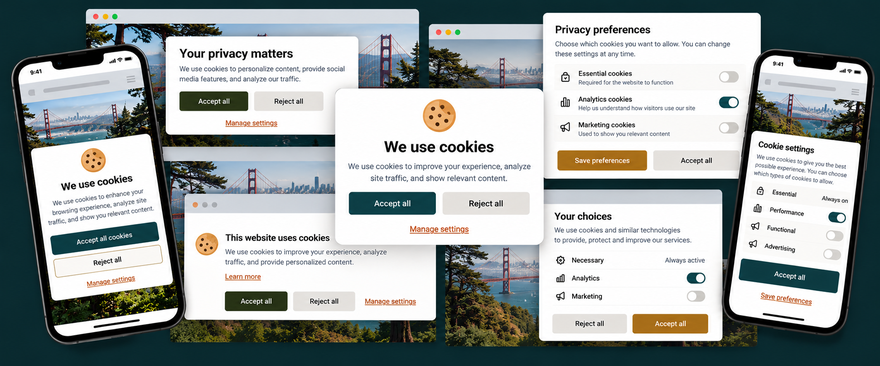
For many small California business websites, no. California doesn’t automatically require cookie-consent popups simply because a website uses ordinary cookies or traffic analytics.
Information current as of October 30, 2026. Privacy laws and requirements may change. This article provides general information, not legal advice.
You visit a website looking for something simple. A phone number. Business hours. Maybe you want to book an appointment.
But first, a popup demands that you accept cookies, reject cookies, or manage your privacy preferences.
Choose “Manage Preferences” and suddenly you’re faced with mysterious switches and technical jargon.
All you wanted was a haircut.
WHAT ARE COOKIES, ANYWAY?
Cookies are small pieces of information stored in your browser. Some help websites function, while others remember preferences, measure traffic, or support advertising.
A typical small-business website might use essential cookies, Google Analytics to measure website traffic, and Google Ads conversion tracking to see whether advertising generates inquiries.
Using these technologies doesn’t automatically mean a California business needs a cookie-consent popup.
However, certain advertising practices, privacy laws, or tracking technologies may require additional consent or opt-out choices. What matters is how your website actually operates.
THEN WHY DO SO MANY WEBSITES HAVE THESE POPUPS?
There are several reasons, and not all involve legal requirements.
1. EUROPEAN PRIVACY LAWS
European privacy rules generally require consent before using many nonessential cookies. Those requirements don’t automatically apply to local California businesses.
2. ONE-SIZE-FITS-ALL SOFTWARE
Cookie-consent plugins are easy to install, and developers sometimes use them by default. Large companies may also apply the same privacy settings worldwide, whether they’re necessary in every location or not.
3. ADVERTISING TRACKING
Websites using remarketing and other extensive tracking technologies may need additional privacy controls. But not every website uses these technologies.
4. FEAR OF LAWSUITS
Some businesses install popups as a precaution against privacy-related lawsuits, even when a particular law doesn’t expressly require them.
The irony? Having a cookie popup doesn’t automatically make a website legally compliant.
WHAT SHOULD A SMALL CALIFORNIA BUSINESS DO?
Consider a local salon, designer, or real estate business using a contact form, Google Analytics, and perhaps Google Ads conversion tracking, but no remarketing.
For a website like this, a cookie popup isn’t automatically required. The business should disclose its tracking practices and determine whether any additional privacy controls are necessary.
Even without advertising remarketing, some website tracking technologies can create privacy-related legal risks. Recent changes to California law reduce certain types of lawsuits but don’t eliminate those risks. That’s another reason to understand exactly what your website collects and shares.
Businesses serving European customers or using more extensive tracking may have different obligations.
Don’t install a cookie popup just because everyone else has one. First determine whether your website actually needs it.
BETTER PRIVACY DOESN’T HAVE TO MEAN MORE POPUPS
Visitors deserve to know how their information is collected and used. But forcing them through an unnecessary consent screen doesn’t automatically protect their privacy.
Your website should respect visitors’ privacy, not make them work unnecessarily hard to visit your business.
At Metapix, we believe in straightforward privacy practices, appropriate protections, and websites that let visitors get on with what they came to do.