WHY MANY GOOGLE ADS PROS ARE SKEPTICS OF PERFORMANCE MAX (PMax) ADS

WHY MANY GOOGLE ADS PROS ARE SKEPTICS OF PERFORMANCE MAX (PMax) ADS


Over the past few years, Google has strongly encouraged advertisers to adopt its automated campaign type known as Performance Max, or PMax. The concept sounds attractive: upload creative assets, choose a conversion goal, and Google’s AI distributes ads across Search, Display, YouTube, Gmail, Discover, and Maps while continuously optimizing performance.

For many small businesses, this sounds like an easy way to run sophisticated advertising campaigns. But as someone who manages Google Ads campaigns for small, local service businesses, I approach Performance Max cautiously. While automation can be helpful, PMax often removes the very controls that make digital advertising effective—especially for service-based companies that depend on high-intent leads.

One of the most significant concerns is the lack of control over keywords and search intent. In traditional Google Ads search campaigns, I can choose exactly which keywords trigger ads. I can separate exact match and phrase match searches, review detailed search term reports, and build extensive negative keyword lists to prevent wasted clicks.

Performance Max does not provide that same level of precision. Instead, the system relies on broad signals and automation to decide when ads appear. Advertisers receive far less visibility into the search queries actually triggering ads. For service businesses, this matters greatly. A law firm, contractor, or medical practice typically wants to reach people who are actively searching for a specific service—not people casually browsing general information.

Another issue is control over ad messaging. In well-structured search campaigns, ads are carefully written to match the intent behind specific searches. Someone searching for “emergency plumber near me” should see different messaging than someone searching for “cost to replace water heater.”

Performance Max operates differently. Advertisers provide groups of assets—headlines, descriptions, images, and videos—and Google automatically mixes and matches them across placements. While this automation can produce variations quickly, it also means advertisers cannot control exactly which message appears for a given search query. The result can be messaging that feels generic or misaligned with the user’s intent.

The same limitation applies to ad extensions, which are a major part of successful Google Ads campaigns. Sitelinks, callouts, structured snippets, call buttons, and other extensions often provide critical information that encourages people to click or call. In traditional campaigns, these elements are strategically chosen and carefully organized to support the ad’s message.

With Performance Max, Google frequently decides how and when extensions appear, and in some cases generates them automatically. That reduces the advertiser’s ability to shape how ads are presented to potential customers.

Another challenge is the limited transparency in reporting. Traditional search campaigns provide detailed information about search terms, placements, and performance metrics. This level of visibility allows campaigns to be refined over time through careful analysis and optimization.

Performance Max, however, often functions as a kind of “black box.” Advertisers see summary performance data, but many of the details behind how the campaign is spending money remain hidden. That makes it difficult to determine which parts of the campaign are producing results and which parts may simply be consuming budget.

Budget allocation is another concern. Because PMax spreads ads across multiple Google networks, spending can shift toward display impressions or YouTube placements rather than high-intent search traffic. For many service businesses, the most valuable leads come from people who are actively searching for a service at that moment. Awareness impressions on display or video networks rarely produce the same quality of leads.

For these reasons, traditional Google search campaigns remain the superior approach for many service businesses. They allow full control over every important element of the campaign: keywords, match types, negative keywords, ad copy, extensions, targeting, and bidding strategies. Advertisers can see exactly which search terms are triggering ads and refine campaigns accordingly.

That level of control makes it possible to align messaging with user intent, eliminate wasted clicks, and continuously improve performance over time.

Automation will certainly continue to play a role in digital advertising. But for many small service businesses, success in Google Ads still depends on something much simpler: precise targeting, clear messaging, and complete visibility into how advertising dollars are being spent. Traditional search campaigns provide those advantages in ways that fully automated systems like Performance Max often cannot.


THE EFFECT OF AI SEARCH OVERVIEWS ON GOOGLE ADS

THE EFFECT OF AI SEARCH OVERVIEWS ON GOOGLE ADS


The Shifting Landscape: Google AI Overviews and the Future of Small Business Advertising

Google’s introduction of AI Overviews in search results has fundamentally reshaped the digital marketing landscape, prompting a re-evaluation of established strategies for small businesses. While the change presents new challenges to traditional ad visibility and organic traffic, Google Ads will continue to be an essential, though evolving, part of a small business’s toolkit.

The primary impact of AI Overviews stems from their prominent placement at the top of the search results page (SERP), which pushes both organic listings and traditional ads further down the screen, often below the fold.

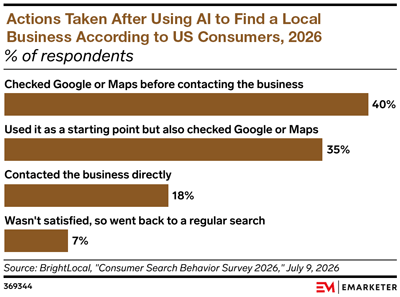
  • Decreased Click-Through Rates (CTR): Because AI Overviews provide immediate, synthesized answers, users can get the information they need without clicking on any links (known as “zero-click” searches). Studies have shown significant drops in CTR for both organic and paid results when an AI Overview is present.
  • Increased Competition and CPCs: With fewer prime ad placements above the fold, advertisers are bidding more aggressively to maintain visibility, leading to higher costs-per-click (CPCs).
  • Shift in User Behavior: Users who do click through from AI-influenced searches may have a higher commercial intent, resulting in potentially higher quality, albeit lower volume, traffic and conversion rates.

 WILL GOOGLE ADS REMAIN ESSENTIAL FOR SMALL BUSINESSES?

Google derives a vast majority of its revenue from advertising and has no intention of cannibalizing this “golden goose” so Google Ads will remain an essential part of a small business’s business development toolkit.

For small businesses, ads offer a level of precision targeting that organic methods cannot match as they allow businesses to specifically target users with local services queries.

HOW GOOGLE PLACES ADS IN THE NEW SEARCH FORMAT

Google is blending ads into the AI-enhanced search experience in several ways.

  • Above, Below, and Within the Overview: Ads, marked with a clear “Sponsored” label, can appear in several positions relative to the AI Overview box.
  • Contextual Relevance: The ad system now considers not only the user’s query but also the context of the AI-generated answer to determine ad relevance. This opens up new opportunities for ads to appear in “previously inaccessible moments of high relevance” when a user is researching a problem that a product or service could solve.

 In the age of AI Overviews, success in Google Ads requires a strategic shift. Small businesses should focus on crafting highly relevant ad copy and landing pages that mirrors an informational tone to appear in these new contextual placements.

By adapting their strategies to align with the AI-first search environment, small businesses can continue to leverage Google Ads as a vital tool for growth.


BLOG POSTS ARE VITAL FOR YOUR SEO/GEO EFFORTS

BLOG POSTS ARE VITAL FOR YOUR SEO/GEO EFFORTS
log posts remain popular and continue to evolve as a key component of websites

Blog posts remain popular and continue to evolve as a key component of websites

Twenty years ago we started to recommend posting regularly to blogs as part of SEO best practices. Clients who did so (or had us handle content creation and blog management)  improved their organic search results ranking.

Through the years we have continued to recommend posting regularly to their blogs. It’s one of the tools we use to build “authoritative” websites and attract thousands of potential customers for our clients.

Today, yes, the more things change, the more they stay the same! With AI and GEO, you need strong content written in a specific way. And right now the best way to achieve this and rebuild your organic search results as people move away from search engine and to Chatgbt, Gemini, etc is with regular blogging.

Blog posts remain popular and continue to evolve as a key component of websites for small businesses. While social media and video content have gained traction, blogs are still widely read for their in-depth information, niche expertise, and ability to provide value for SEO. To be successful today, blogs need quality, skimmable content with clear headings and succinct paragraphs.

WHY BLOG POSTS ARE STILL A CRUCIAL PART OF YOUR SEO/GEO TOOLKIT

  • Information Source: People still turn to blogs to find in-depth answers, product reviews, and educational content that may not be available on other platforms.
  • SEO Value: Blog posts are a fundamental tool for Search Engine Optimization (SEO) and generative engine optimization (GEO), appearing frequently in search engine results and AI summaries and helping websites rank higher for various queries.
  • Niche Content: Blogs provide a platform for detailed, personal stories and specialized information on niche topics that are often hard to find elsewhere.
  • Business Strategy: For businesses, blogs serve as an integral strategy for establishing authority, increasing expertise, and providing value to customers.

HOW TO MAKE A BLOG SUCCESSFUL TODAY:

  • Quality and Quantity: Focus on creating high-value content that meets specific user interests as well as publishing regularly.
  • Skimmable Content: Structure your blog posts with descriptive headings, bullet points, and short paragraphs to accommodate modern readers’ shorter attention spans.
  • Niche Focus: Specializing in a niche subject helps you stand out and positions you as an authority to your target demographic.


STAYING VISIBLE IN THE AGE OF AI


STAYING VISIBLE IN THE AGE OF AI

How Business Owners Can Adapt for Generative Search Results

As web browsers and search engines—like Google’s Search Generative Experience (SGE) or Microsoft’s AI-enhanced Bing—increasingly integrate generative AI technologies, website managers and business owners are noticing shifts in how organic traffic reaches their sites. Unlike traditional search, where users click through ranked results, generative AI often summarizes answers at the top of the page, reducing clicks but still heavily relying on credible sources. The challenge: how do you ensure your website becomes one of those trusted sources?

THE SHIFT FROM SEARCH RESULTS WEB PAGE LINKS TO AI-GENERATED ANSWERS

Generative search pulls information from multiple high-authority sources to synthesize a quick, user-friendly response—sometimes without any click required. This has profound implications for SEO. Pages may now be cited in AI-generated responses without receiving clicks from the normal search result listings.

PROACTIVE STRATEGIES FOR AI SEARCH VISIBILITY

To thrive in this evolving environment, website owners must re-evaluate their content and site architecture with AI in mind:

  • Focus on High-Quality, Authoritative Content: AI prioritizes content from trusted sources. Double down on establishing E-E-A-T (Experience, Expertise, Authoritativeness, Trustworthiness) as you update your website. Cite credible sources when appropriate, create valuable content, and offer unique perspectives on your products and services that AI models can leverage.
  • Structure for Clarity and Scannability: AI systems excel at parsing well-organized content. Utilize clear headings (H1, H2, H3), bullet points, numbered lists, and concise paragraphs. Implement FAQ sections and “how-to” guides, as these formats are prime candidates for direct inclusion in AI-generated answers.
  • Prioritize User Intent and Conversational Language: AI search often involves more natural, conversational queries. Optimize your content to directly answer questions users might ask, and consider incorporating question-and-answer formats naturally within your text.
  • Improve Site Architecture: Ensure clean navigation, fast loading times, mobile responsiveness, and structured URLs. A logically organized site improves crawlability and contextual understanding by AI systems.

THE BOTTOM LINE

The landscape of search is rapidly transforming. Generative AI isn’t killing SEO—it’s evolving it.  By proactively updating your content and site structure with AI’s preferences in mind, website managers and business owners can not only mitigate potential traffic loss but also position their sites to be recognized as authoritative sources to ensure they’re not just found by machines, but also chosen by them to show as cited web pages in AI answer summaries.

Header photo Dress Code by Susan Graf, Healdsburg